

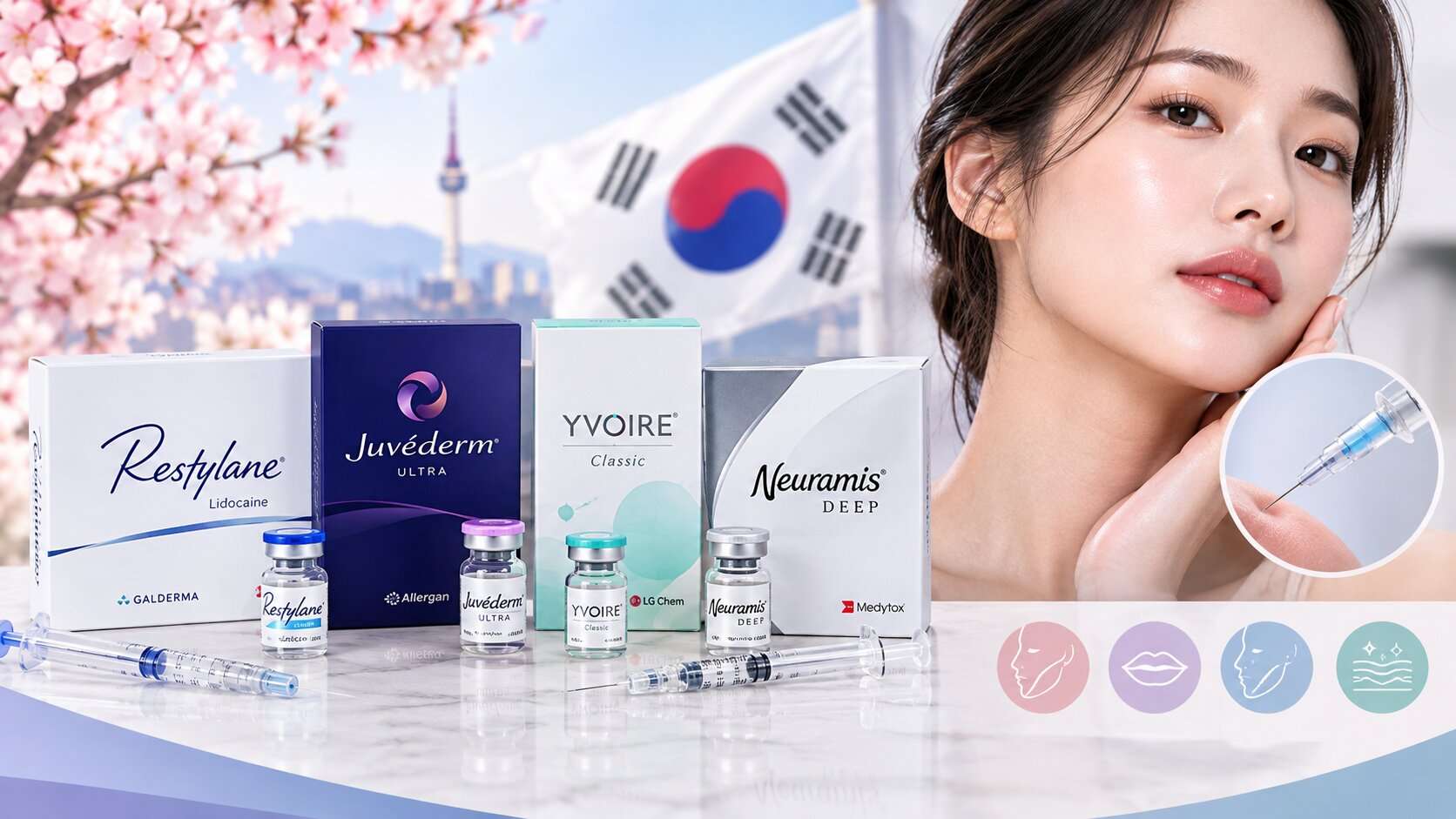
Korean HA fillers are available in clinics throughout Asia, the Middle East, Latin America, and Europe. Demand is steady. Prices are competitive. However, the market is saturated, and not every brand is right for everyone. This guide compares four popular names and what to look for before ordering.
| Brand | Manufacturer | Product Range / Examples | Key Differentiator |
|---|---|---|---|
| Neuramis | Medytox | Neuramis Light, Neuramis, Deep, Volume, with and without lidocaine | Wide range across fine lines to volume, strong brand name in the Korean market |
| Moran | Sebom Bio | HA fillers for fine lines, folds, and volume | Newer name with focus on export distribution |
| Yvoire | LG Chem | Yvoire Classic, Contour, Volume, with lidocaine options | Backed by a large chemical and life sciences group |
| Revolax | Across Co., Ltd. | Revolax Fine, Deep, Sub-Q | Clear product tiers by injection depth |
Neuramis is one of the most famous Korean-name fillers. Medytox makes it, a firm better known for its use of botulinum toxin. This line is available in a range of viscosities. Lighter shades are ideal for applying around the eyes and lips. Heavier grades will focus more on the folds and volume loss on the jawline and cheeks. Neuramis products are generally available in 1 ml prefilled syringes. Lidocaine forms are readily available and frequently at the 0.3% level. The wide selection is popular with customers. Most clinics can use one brand to meet all HA needs, making ordering easy.
Moran is the filling brand from Korean company Sebom Bio, based in Hwaseong-si, Gyeonggi-do. Compared to the older names, the brand is less recognized worldwide. That works two ways. Distributors might find better terms and open territories. But buyers will need to do more homework on documentation and track record. Moran fillers are HA-based, cross-linked products that are used for facial contouring and wrinkle correction. In addition, Sebom Bio produces skin rejuvenation injectables, allowing the distributor to expand its catalog beyond a single supplier. Request the latest product sheets, as range sizes and names vary from market to market.
LG Chem, a large Korean chemical group with a life sciences division, makes Yvoire. Other buyers feel that corporate support is important. It recommends well-established supply and formal quality systems. The brand has been available for years and is approved by regulatory authorities in various regions. It offers several options ranging from Yvoire Classic for finer lines to Contour and Volume for shaping and lifting. Lidocaine versions are available. Yvoire is a little more expensive than newer Korean brands. What buyers typically pay for is the manufacturer's size and reputation.
Revolax comes from Across Co., Ltd. The brand is known for a simple design consisting of three tiers. Fine is for shallow lines. Deep is to indicate deeper folds and moderate volume. Sub-Q is for volumizing in deeper layers. This makes training new injectors easier and keeps stock clean. Revolax has established a strong export profile, particularly in Asia, Latin America, and portions of Europe. Packs typically include 1.1 ml of lidocaine per syringe. A clear, tiered range is a first choice for buyers looking for a clear range.
Most Korean fillers use cross-linked hyaluronic acid. Cross-linking controls the final gel-life and skin feel, sometimes using BDDE. Different brands may have a different concentration of HA, typically 20 mg/ml or 24 mg/ml. They also vary in their particle size, cohesivity, and lifting ability. These details affect the outcome of the results. A softer gel fuses with the thin skin. A firmer gel will form in the chin or jaw area. Ask each supplier for rheology data, not just marketing words. Fine-line products typically have a time frame of 6 to 12 months, and volume grades could be as long as 18 months. The actual duration depends on the patient and injection sites.
Clinics that are interested in one supplier need to know about range size. Some brands offer five or six viscosity levels. Some limit themselves to 3. Match the range to your injectors' needs. Lip and under-eye clinics require different products than facial contouring clinics. Determine which products contain lidocaine. Most clinics prefer to use it for patient comfort. Always check the size of syringes and cannula or needle packs. Products are shipped with 27G or 30G needles included. Others must be bought separately. Little things make a difference to your cost per treatment.
Each of these Neuramises, Moran, Yvoire, and Revolax has something to offer. Choose based on your market, your injectors' requirements, and your regulatory restrictions. Read the documents for accuracy, verify authenticity, and get the terms in writing. A bit of research before the first order will save a lot of trouble afterward.
Most are not. Most Korean fillers are approved by the Korea MFDS and typically have CE marking. The FDA requires a premarket process for the US. Always check the FDA database to confirm a product's status.
Korean fillers are generally more affordable and have a wider range of products. Lidocaine is used in many as standard. Western brands will typically have a longer clinical history and, for some of them, US FDA approval. We will base this selection on market, budget, and regulatory requirements.
Contact the manufacturer or the manufacturer's export team directly. Complete your company registration, import license, and market information. Don't be surprised when people ask for sales projections or minimum orders. Additionally, many suppliers will require that you demonstrate medical or aesthetic distribution experience.
Request MFDS approval, CE certificate, ISO 13485 certificate, batch Certificate of Analysis, Instructions for Use, and product specification sheets. If your country needs a sales certificate, ask for one as well. Check each piece of paper separately.
Korean HA fillers are available in clinics throughout Asia, the Middle East, Latin America, and E
READ FULLA syringe mixing tube is a connector designed to link two syringes so that material can be transf
READ FULLKorean lip filler inkections have moved from being a niche alternative to becoming a serious cons
READ FULL

Have a question or need a quote? Fill out this form and our team will get back to you quickly!