

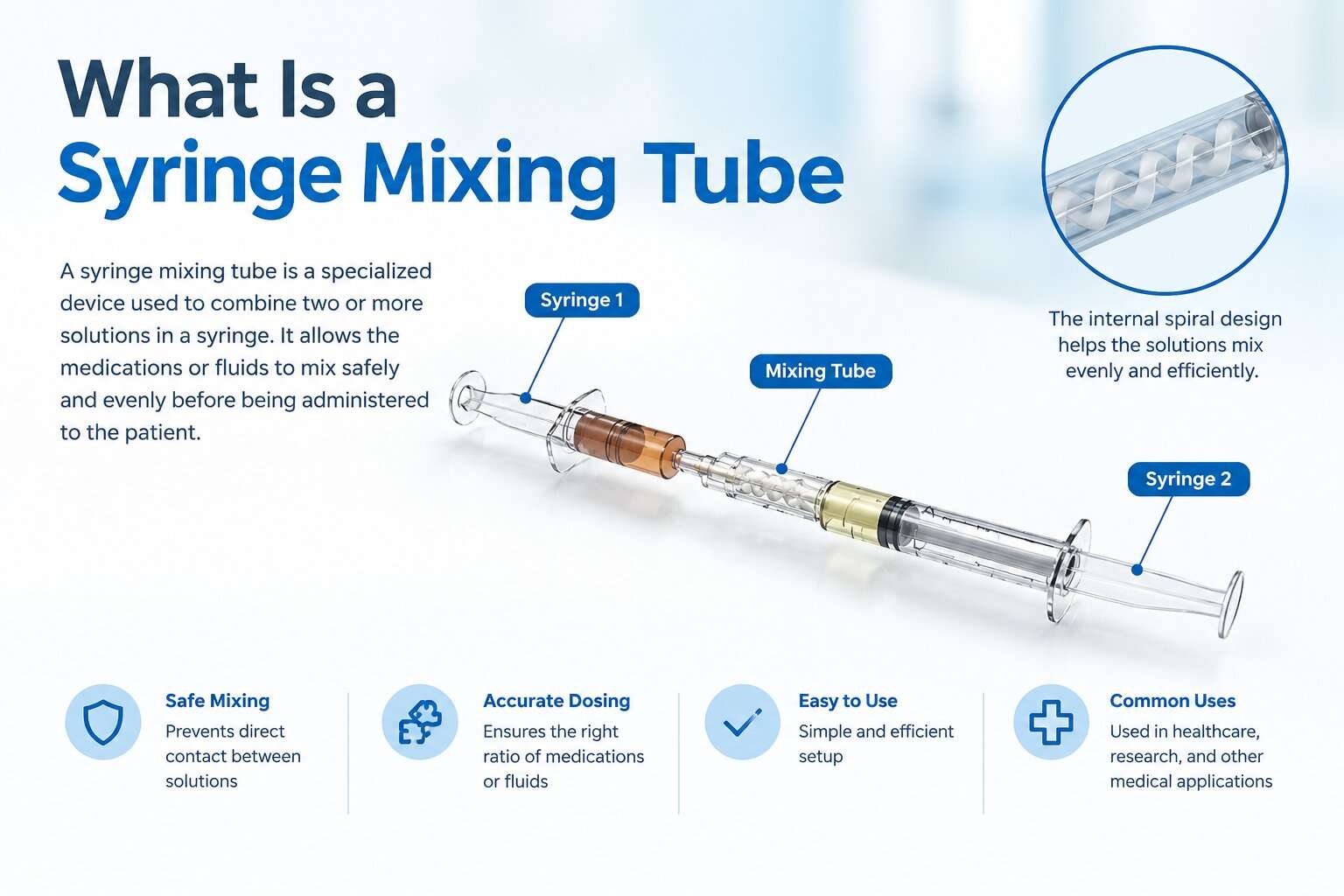
A syringe mixing tube is a connector designed to link two syringes so that material can be transferred back and forth between them. In medical and aesthetic practice, this setup can help you mix certain injectable products more evenly or transfer a prepared product into smaller syringes when appropriate.
To an inexperienced medical professional unfamiliar with syringe mixing tubes, the connector itself can look deceptively simple. The important part is understanding how the fittings work and which syringes are compatible. Another important skill is how to handle the connection without compromising sterility.
Mixing tube is a vital medical device that every medical practitioner should know about. Although it does not replace proper product preparation instructions, it still makes mixing compatible solutions much more precise.
A syringe mixing tube connects two syringes through compatible fittings. You attach one syringe to each end of the tube and use the syringe plungers to move the solution from one syringe to the other.
That back-and-forth movement is what creates the mixing action.
The exact connection depends on the type of fittings used on the syringe and tube. Before you begin, check that the components are designed to connect securely.
Luer fittings are widely used connection systems for medical devices. They are compatible with syringes, needles, and tubing.
A male Luer fitting is designed to lock into a corresponding female fitting. When the two sides are compatible, the connection creates a pathway through which the material can pass.
And this is where beginner-level practitioners make the mistake of using an incompatible Luer fitting. A fitting may appear physically similar to another connector but will not be suitable for the intended injection.
So, always check the connector specification rather than on just visual confirmation.
In clinical settings two common syringe connection styles are mostly used: Luer-Lock and Luer-Slip.
A Luer-Lock connection has a threaded mechanism that helps connect the syringe to the corresponding fitting. This can provide a more secure and leak-proof connection during handling.
A Luer-Slip connection has no threading and fits the syringe tip directly into the connector.
That difference in connection design matters when you select a mixing tube. The tube must be compatible with the connection system of the syringes.
The basic process involves connecting two compatible syringes so that the the solutions are transferred between them in a controlled manner.
But the exact mixing procedure varies from the type of solution or formulation. You should always follow the product manufacturer's preparation instructions.
Step 1. The first thing to check is that the syringes, mixing tube, and product are all compatible with each other. Look at the syringe sizes and connector types before opening or assembling the components.
Step 2. Do the product preparation following the manufacturer-provided instructions. If the product/formula requires reconstitution or another preparation step, complete that step using the specified technique.
Step3. Once your product has been prepared, connect the first syringe to one end of the mixing tube and the second syringe to the other end. Make sure each connection is tight and secure before pressing the plungers of both syringes.
Step 4. Once connected, transfer the material between the syringes in a controlled back-and-forth motion. Avoid excessive force. The goal here is controlled transfer.
Continue only for the number of transfer cycles or the mixing method specified for the specific formulation. Different formulations mix at different rates, especially when viscosity is high.
After mixing, inspect the connection and the material. Check for leakage, unexpected separation, or other visible issues.
That means you should not treat every syringe mixing procedure as the same. The mixing tube provides a leak-proof connection, but the formula preparation instructions determine how that product should be handled.
A syringe mixing tube's has another important function as well. It is an efficient device for transferring material from a larger syringe into smaller syringes.
This is incredibly useful when a prepared product needs to be divided into smaller dosages for a particular workflow.
Here also care needs to be taken that not every injectable product can be portioned this way. Many factors like product labeling, sterility requirements, and storage conditions will make dividing the product a wrong approach.
So, before transferring material into multiple syringes, ensure that this procedure is permitted for that product or not. In many cases sterility of the product cannot be maintained during transfer.
The goal is not simply to make several smaller syringes. The goal is to do so without compromising the product purity.
In aesthetic clinics, practitioners have workflows involving dermal fillers, skin boosters, or other injectable products.
For fillers and skin boosters, factors such as viscosity and formulation determine how easily a material flows through the connection.
Toxins require more skilfull preparation and greater attention-to-detail because their preparation and handling instructions are very product-specific. A mixing syringe tube is not the only method for combining injectable products and where appropriate other methods can be used also.
Junior proofessionals usually make the mistake of assuming that the connector makes two products compatible if they are able to mix well. Mixing well does not mean that the products are compatible.
Prefilled products are generally supplied in a ready-to-use syringe or another prepared format. Only some of the products require preparation before use.
Lyophilized products, for example, require reconstitution according to the manufacturer's instructions.
If a product requires reconstitution, everythingshould be doe according to a specific procedure. The specified diluent, volume, preparation method, and handling instructions should be followed accurately. Moreover, if you are working with a prefilled product, follow its labeling and intended-use instructions instead.
Compatibility is one of the most important checks before using a syringe mixing tube.
The tube must be compatible with the syringes, the connector system, and the intended material.
Start by checking the syringe size and fitting type on both sides.
For example, if one syringe uses a Luer-Lock connection and the other requires a different connector arrangement, the mixing tube must accommodate the specific configuration.
Do not assume that a tube designed for one syringe combination will work with every syringe.
You should also consider whether the syringe volume is appropriate for the transfer you are performing. A larger syringe may provide a different level of control than a smaller syringe.
So, check the complete setup before beginning:
Syringe size. Connector type. Tube compatibility. Product requirements. Manufacturer instructions.
These basic checks can prevent a surprisingly common problem: discovering an incompatibility after the product has already been prepared.
Some injectable materials have a relatively high viscosity. These materials require more controlled pressure and care during transfer since they have a thinner consistency. The practitioner should use smooth, controlled movements to keep the mixing process controlled.
One thing to keep in mind when working with highly viscous solutions is to remember that mixing tube does not change the physical properties of the material. A highly viscous product will still behave like a highly viscous product.
Safe handling starts before the syringes are connected.
You should inspect the packaging, confirm that the components are appropriate for the procedure, and work using the aseptic technique required by your clinical setting.
Syringe mixing tubes intended for single use injections should not be reused. Reusing a device introduces a contamination.
Use sterile components when the clinical application requires them, and follow the manufacturer's instructions for handling and disposal. This involves treating the mixing tube as part of the sterile pathway and not simply a piece of tubing that has no impact on sterility.
Secure connections is vital for stopping leakages. The best practice in this case is that before transferring material, check that each syringe is properly connected to the tube. If the connection is loose, material may leak or the system may no longer provide the intended controlled pathway.
Avoid touching sterile connection points unnecessarily. Keep the setup organized and minimize handling.
If you notice leakage, damaged packaging, a compromised component, or another unexpected problem, stop and assess the situation according to your facility's protocol.
Small shortcuts can create bigger problems.
A syringe mixing tube offers a direct way to connect two syringes and transfer material between them.
Compared with transferring material through separate containers, a syringe-to-syringe setup makes clinical procedure easier and quicker for the practitioner if it is feasible.
But the simplest method is not automatically the correct method.
Your choice should depend on the product manufacturer's instructions, the required preparation method, the syringe configuration, sterility requirements, and the clinical workflow.
For beginner practitioners, that is the key takeaway: choose the method based on the product and procedure, not simply on which device appears easiest to use.
A syringe mixing tube provides a reliable connection between compatible syringes to implement a controlled transfer or mixing of medical or aesthetic products. But using one correctly involves more than connecting two syringes.
Connector compatibility, understanding the product's preparation requirements and maintaining appropriate sterility are some crucial aspects that should always be confirmed and checked before the syringes are linked together. Handling requirements also matter a lot from product to product.
So, if you are new to syringe mixing tubes, start with the step-wise approach that we discussed in the blog.
That approach keeps the device in its proper role: a practical connection tool that supports an established medical workflow, rather than a substitute for product-specific preparation and safe clinical practice.
If the mixing tube is labeled or intended for single use, you should not reuse it. Follow the manufacturer's instructions and your facility's infection-control and disposal protocols.
The answer depends on the specific mixing tube and its connector configuration. Check the manufacturer's specifications to confirm which syringe sizes and fittings are compatible.
No. Mixing tubes are designed for specific connector configurations. You should verify whether the tube supports the Luer-Lock, Luer-Slip, or other connection type used by your syringes before beginning the procedure.
A syringe mixing tube is a connector designed to link two syringes so that material can be transf
READ FULLKorean lip filler inkections have moved from being a niche alternative to becoming a serious cons
READ FULLScars do more than change the texture of your skin. For many patients, they affect how comforta
READ FULL

Have a question or need a quote? Fill out this form and our team will get back to you quickly!