

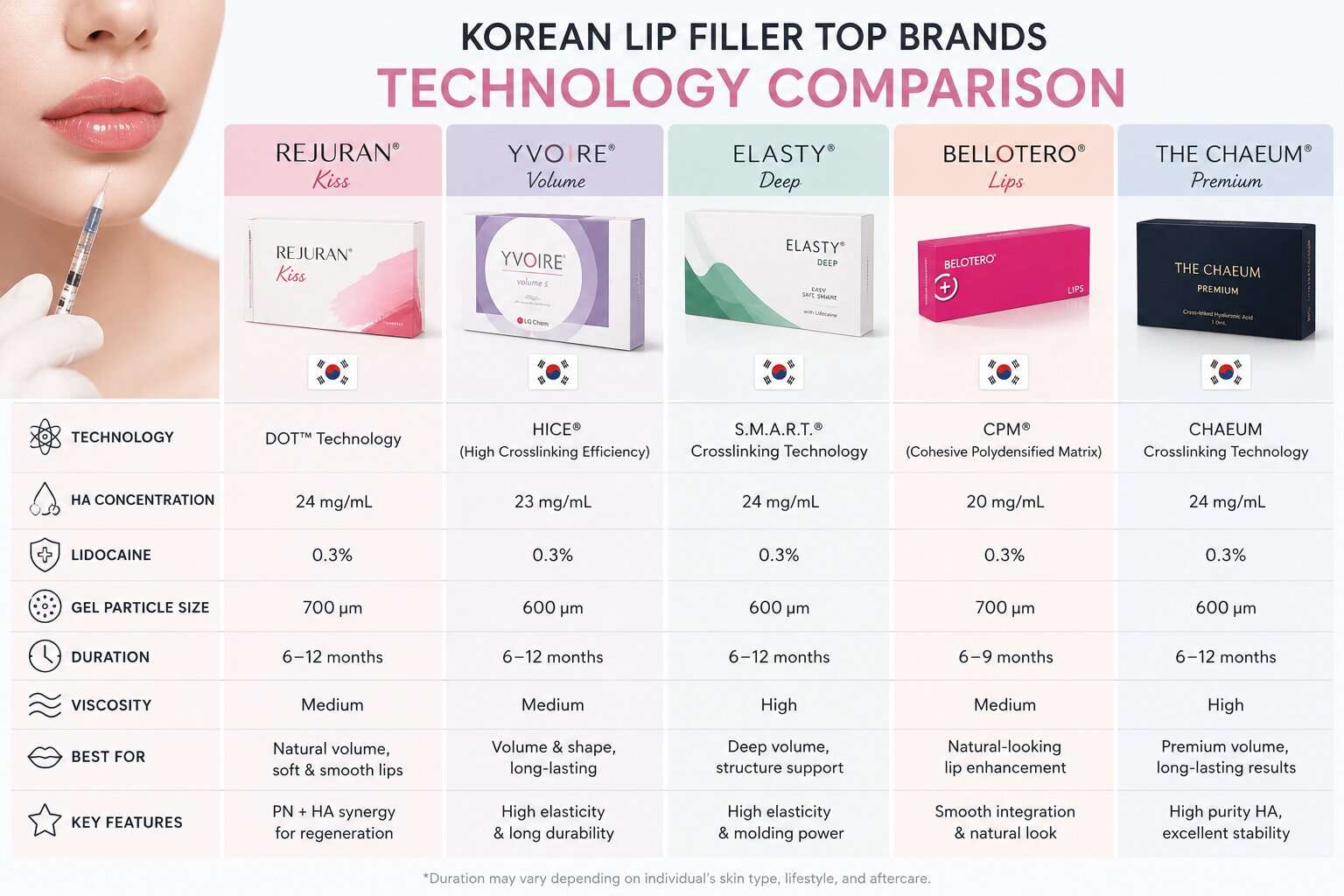
Korean lip filler inkections have moved from being a niche alternative to becoming a serious consideration for clinics and aesthetic distributors building broader injectable portfolios. The attraction is straightforward: Korean manufacturers offer a wide range of hyaluronic acid (HA) fillers, multiple gel profiles, and pricing that can create room for competitive treatment packages.
But lower acquisition cost alone does not make a filler commercially profitable to sell or utilize in treatments. You need to consider texture, cross-linking technology, clinical evidence, regulatory status, product consistency, and where the filler actually fits into your treatment menu.
That is why comparing Korean lip fillers requires more than looking at brand names. You need to understand what each product is designed to do and whether its positioning gives your clinic a competitive edge among countless other enhancement clinics or not.
Most Korean lip injections are based on cross-linked hyaluronic acid. HA is naturally present in human tissues and is widely used in temporary dermal fillers because it can create volume and is eventually absorbed by the body.
The Korean dermal filler market has developed around increasingly specialized HA formulations. Instead of treating every filler as interchangeable, Korean filler manufactures offer product lines consisting of multiple variants that are differentated on the basis of gel concentration, cross-linking, cohesivity, elasticity, particle structure, and intended treatment depth.
This makes practical sense from a treatment perspective as well.
A clinic may need a softer product for lip hydration and definition, while another treatment requires greater projection or structural support. A lip fillers brand wholesaler, meanwhile, might want a portfolio that covers several clinical applications rather than relying on a single filler SKU.
So the value of Korean fillers is not simply that they can be more cost-competitive. It is the ability to build a diversified product lineup around different clinical requirements.
Neuramis is one of the better-known Korean HA filler brands and has clinical evidence supporting the performance of specific formulations. In a randomized study involving 88 Korean subjects, Neuramis Volume Lidocaine demonstrated a 96.39% response rate at 24 weeks and was found non-inferior to Juvederm Voluma for the studied mid-face indication.
A later two-year extension study also reported comparable longevity and safety between Neuramis Volume Lidocaine and Juvederm Voluma in Asian subjects.
But remember, those studies concern specific Neuramis formulations and indications, not every Neuramis product or lip treatment.
If you are procuring fillers for a clinic, these kind of reearch studies do hold weight. But treating the clinical proof as universally acceptable across the whole product line of a Korean brand is the wrong appraoch when deciding for including it in any treatment menu.
Revolax is another established Korean HA filler brand with multiple formulations positioned for different levels of correction and treatment requirements.
For a clinic owner, what makes Revolax brand so appealing is the diversity of product portfolio. Rather than purchasing a filler simply because it has a recognizable name, treatment professionals can assess individual Revolax formulations according to the type of lip work treatment.
And for wholesalers, product diversity offered by Revolax can make the brand easier to position across different clinic segments. The important question is not whether the entire Revolax range is suitable for lips, but which specific product matches a particular lip treatment application, formulation, and market authorization for your region.
Yvoire, manufactured by LG Chem, is another major Korean HA filler brand with published clinical evidence of its effectiveness.
Research comparing Yvoire formulations with established international filler brand products has found similar rheological properties for certain products. Yvoire Classic s, for example, showed rheological characteristics comparable to Restylane in one randomized study, while Yvoire Volume s was comparable to Perlane for the studied indication.
Long-term observational research involving more than 1,000 participants also examined Yvoire Classic s and Yvoire Volume s, with most complete clinical biodegradation occurring within the 104-week observation period.
That gives Yvoire a useful evidence base when you are evaluating Korean brands against established imported products.
Dermalax is another Korean HA filler family commonly available in international aesthetic markets.
Its commercial relevance is similar to other Korean brands: you should assess the individual formulation rather than treating the brand as one uniform product. Different versions can have different physical properties and intended applications.
So if you are building a treatment menu, compare the specific Dermalax SKU product against the role you need it to perform. For wholesalers, this same approach helps prevent an overly broad product catalog wheremore than one alternatives for a specific use case only confuses the customer.
Cross-linking determines how HA molecules are connected within the gel and strongly influence physical properties such as durability, elasticity and viscosity.
BDDE, or 1,4-butanediol diglycidyl ether, remains the most widely used cross-linking agent in HA dermal fillers.
But your product research should not stop at whether BDDE is used in the formula or not. You also need to consider the manufacturing process and residual cross-linker specifications.
So, when comparing products, ask filler manufacturers for technical documentation rather than relying on marketing claims about “advanced cross-linking.”
Gel structure is a major factor that decides how filler will behave once it has been injected in the skin.
Monophasic gels consist of a more uniform gel structure. Cohesive formulations on the other hand are engineered to maintain a degree of internal integrity. Other properties like elasticity, viscosity and cohesivity help explain why different fillers behave differently in tissue.
For lip-focused treatments, this distinction matters because a practitioner may need different handling characteristics for lip definition, volume and hydration. The kind of lip definition, and hydration are decided by patient preference and a professional assessment before the treatment begins.
And that means you should not build a lineup around brand names alone. Build it around clinical roles.
| Category | Korean Fillers | Imported Fillers |
|---|---|---|
| Pros | Competitive acquisition costs. Can create more room for treatment margins and competitive pricing, depending on supplier and market. Portfolio diversity. Korean manufacturers offer multiple HA formulations, giving you more options for different treatment objectives. Comparable evidence for some products. Specific Korean fillers have performed comparably to established imported products in controlled clinical studies. Strong manufacturing base. Korea has developed a substantial aesthetic-device manufacturing industry, giving distributors access to multiple established brands. |
Established market recognition. Well-known international brands may be easier for clinics to position when patients already recognize the product name. Extensive regulatory and clinical documentation. Some established brands have large evidence bases and long histories across international markets. Regulatory familiarity. Certain imported products have specific FDA approvals for lip augmentation and other indications, although approval must always be checked for the exact product and use. Established distribution networks: Mature brands may offer more developed training, support and supply infrastructure in some markets. |
| Cons | Regulatory variation. Approval in Korea or another market does not automatically mean FDA approval or authorization in your target market. Brand-to-brand variation. You cannot assume that clinical evidence for one Korean formulation applies to every product from the same manufacturer. Lower recognition in some markets. Patients or practitioners may be less familiar with newer or less-established Korean brands. Supplier diligence is essential. You need reliable documentation, traceability and an authorized supply chain. |
Higher acquisition costs. Premium brands can increase your cost per treatment and potentially compress margins. Premium pricing may not equal better outcomes. Clinical performance depends on the specific formulation, indication and treatment area, not simply where the product is manufactured. Less portfolio flexibility. A highly established brand can still leave gaps if its available formulations do not match every treatment role you want to offer. Brand value. You may pay partly for market recognition and established positioning rather than a proportionate improvement in clinical performance. |
Choose Korean fillers for portfolio diversification and cost-efficient positioning when the individual product meets your clinical and regulatory requirements. Choose imported fillers when established market recognition, documentation or regulatory positioning carries greater commercial value for your target market.
If your treatment menu is heavily focused on lip augmentation, start by defining the clinical roles you need to cover.
A softer formulation is relevant when the goal is subtle enhancement or definition. A more structured gel may be considered where greater projection or volume is required.
That can improve inventory efficiency while giving clinics a clearer reason to purchase more than one product from your lineup.
Before adding any Korean filler to your clinic menu, assess the product at three levels.
So if you are a wholesaler, traceability is not just a compliance issue. It is part of your value proposition.
For clinic owners, doing a comprehensive filler comparison covering formulation, intended use, clinical evidence, practitioner preference, acquisition cost and regulatory status is the right strategy for filler selction.
But if you are a dermal filler wholesaler, look beyond unit price and build a lineup with differentiated products, reliable documentation, supply continuity and clear market positioning.
And that is ultimately the advantage of taking a data-driven approach. You are not choosing between “Korean” and “imported” as if either category were a single product. You are comparing individual formulations, manufacturers, evidence bases and commercial models.
The strongest lineup is the one that gives your practitioners the right product for each treatment role while giving your business predictable supply, defensible margins and room to expand its market penetration.
What Should I Ask My Injector About the Korean Filler Brand They Use?
It’s smart to ask about the safety record, clinical approvals, and how the filler performs for natural results. Many clinics offering dermal fillers Korea will explain the differences between brands, so you can feel confident about your choice.
Are Korean Lip Fillers FDA Approved?
Most lip fillers in Korea are approved by the Korean MFDS, but not all have FDA clearance in the U.S. Always check with your injector about the specific brand’s certifications before treatment.
Which Korean Filler Brand Is Best for Natural-Looking Results?
Brands from lip augmentation Korea are often designed for subtle, smooth enhancements. Your injector can recommend the one that best suits your facial features, but Korean fillers are generally known for their soft, natural finish.
A syringe mixing tube is a connector designed to link two syringes so that material can be transf
READ FULLKorean lip filler inkections have moved from being a niche alternative to becoming a serious cons
READ FULLScars do more than change the texture of your skin. For many patients, they affect how comforta
READ FULL

Have a question or need a quote? Fill out this form and our team will get back to you quickly!