

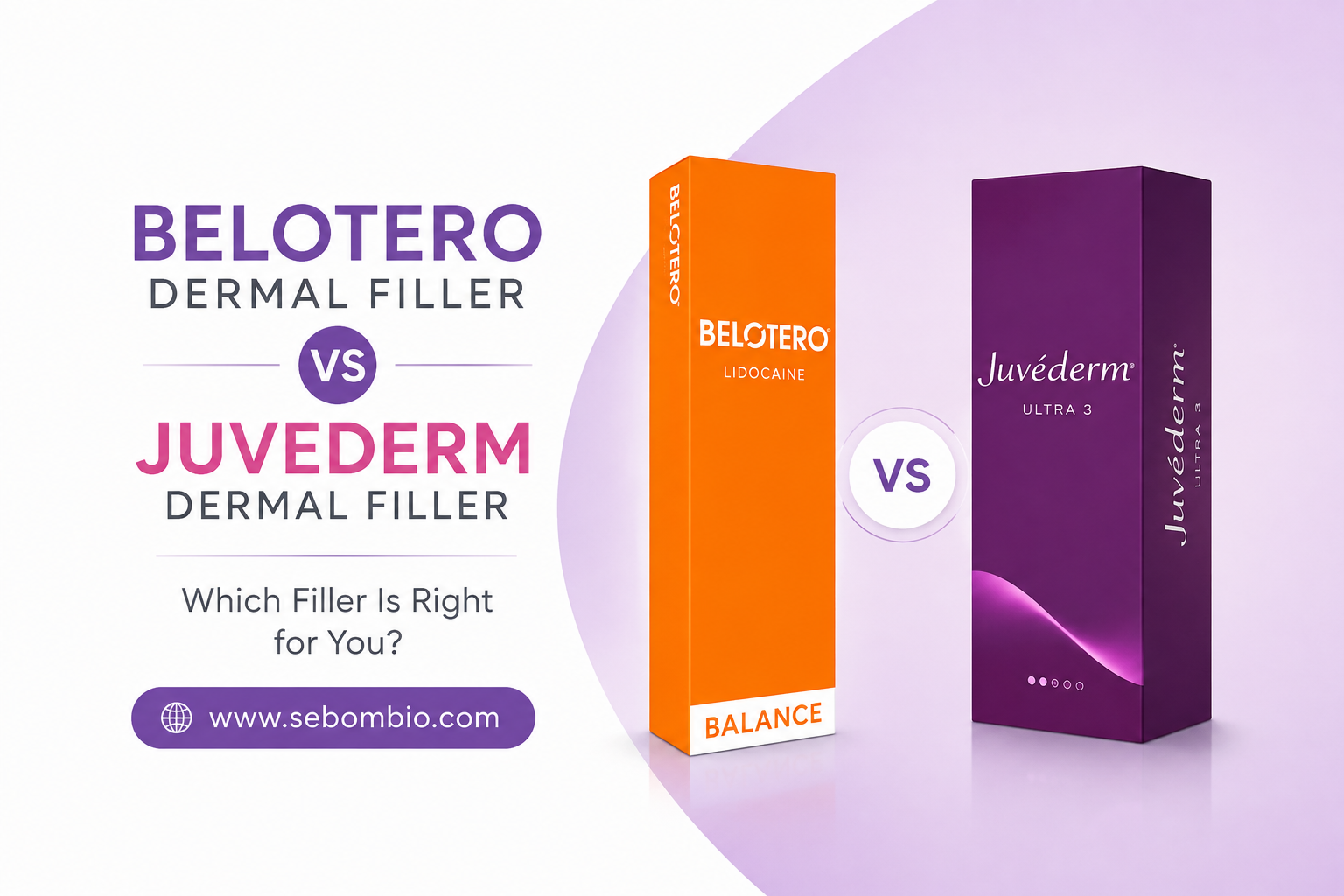
Belotero and Juvederm are both hyaluronic acid (HA) dermal fillers, but they behave differently once injected. Belotero uses Cohesive Polydensified Matrix (CPM) technology for a soft gel that integrates close to the skin's surface. Juvederm relies on Hylacross and VYCROSS technology to build a firmer gel suited to deeper, longer-lasting volumization.
The right choice between the two depends on the gel's properties and the treatment area involved. Both are FDA-cleared HA fillers, though they perform differently in the skin. This guide outlines the science behind each formulation, their product ranges, and the sourcing realities a clinic needs to work through before stocking either line.
| Factor | Belotero | Juvederm |
|---|---|---|
| Manufacturer | Merz Aesthetics | Allergan |
| Core Technology | CPM (Cohesive Polydensified Matrix) | Hylacross / VYCROSS |
| Gel Consistency | Soft, low G-prime | Firmer, higher G-prime |
| Best For | Fine lines, tear troughs, lips | Volume, cheeks, deeper folds |
| Typical Duration | 6-12 months | 6-24 months, depending on formula |
Belotero and Juvederm are both hyaluronic acid fillers that add volume and smooth wrinkles. Both product lines carry a strong safety profile, since hyaluronic acid occurs naturally in skin tissue, and both are reversible when needed. Belotero is a Merz product, FDA-approved in 2011 for moderate to severe wrinkles and folds, including nasolabial folds. Juvederm is an Allergan product, first approved by the FDA in 2008 using Hylacross technology.
Belotero's CPM technology gives the gel a cohesive yet flexible structure, which helps it blend into the skin without leaving raised spots on thin tissue. Newer Juvederm formulas, like Voluma, combine high-molecular-weight HA with low-molecular-weight HA to form a cohesive gel built for larger-volume correction — such as restoring cheek volume — rather than fine-line work.
G-prime describes the firmness of a filler gel, and it shapes how the product behaves once injected. Belotero has a lower G-prime, giving a softer gel suited to the superficial layers of the dermis. Juvederm's VYCROSS and Hylacross formulas carry a higher G-prime, better suited to deeper volumization.
This difference in firmness is why injectors reach for Belotero when working close to the skin's surface. In the mid-to-deep dermis or subcutaneous layer, Juvederm's firmer gels hold their structure better.
Belotero's low-viscosity gel suits small wrinkles and lines around the mouth. Its CPM technology keeps the gel free of visible lumping in fine tissue.
Both brands offer a lip-specific product. Belotero Soft and Juvederm Volbella both work well for discreet lip enhancement — the injector's technique and personal preference often decide between them.
Juvederm Voluma is built to add structure to the contour of the face, using a denser VYCROSS formulation designed for that purpose. Softer gels generally aren't suited to this level of structural support.
Belotero's superficial placement makes it a common choice for tear troughs, where a thicker gel risks a visible bulge. In this delicate area, bruising and swelling largely come down to how deep the injector places the product.
Juvederm generally lasts slightly longer than Belotero due to its firmer gel structure, though both typically hold results from 6 months to a year or more. Juvederm Voluma, placed in deep tissue, can last 18 to 24 months, while Belotero Soft in superficial tissue lasts closer to 6-12 months.
Treatment area, injection depth, and individual patient metabolism all affect duration. Deeper injections in low-movement areas tend to last longer than superficial injections in high-movement areas like the lips.
Belotero comes in several strengths based on injection depth. Belotero Soft is designed for surface work and lips. Belotero Balance targets medium wrinkles and nasolabial folds. Belotero Volume and Belotero Intense are built for more significant volume support and correction.
Juvederm XC includes lidocaine for added comfort, while Juvederm Ultra Plus is a thicker gel formulated to correct wrinkles and folds. Voluma targets the deep cheeks and chin. Volbella (lips) and Vollure (moderate folds) sit between these two.
Both fillers typically last 6-12 months and can be reversed with hyaluronidase if needed. Both can cause swelling, tenderness, bruising, or pain at the injection site, usually noticeable for about a week. Results appear immediately, with visible improvement over the following weeks as swelling settles — recovery timelines are similar for both lines. Vascular occlusion is a rare but serious complication, and injectors need training to recognize and respond to it promptly.
Every clinic has a different patient base, staff training, and treatment mix that shape this decision — there's no single "best" brand for every situation.
Start with the treatment site. Fine lines and tear troughs are surface-level concerns that favor Belotero. Firmer VYCROSS formulations suit structural volume work, such as cheek augmentation.
The product choice matters as much as the injector's familiarity with it. Practitioners often get better results when they build experience with one gel technology before adding the other's injection characteristics to their toolkit.
Clinics serving a varied patient base often stock both lines, alongside other products, so practitioners can match the right gel to each treatment area without compromising technique or outcome.
Korean manufacturers produce a range of HA dermal fillers that compete directly with Belotero and Juvederm on formulation science and price. Some use proprietary cross-linking techniques and achieve comparable G-prime values for both superficial and deep injection.
Look for suppliers who share molecular weight data and disclose their cross-linking agent, the same way Merz and Allergan do. That transparency lets practitioners anticipate how a Korean HA filler will behave in different tissue layers before using it on a patient.
Belotero and Juvederm both deliver consistent results, formulated differently for different treatment areas. Belotero's soft CPM gel suits fine lines and sensitive areas like the tear troughs. Juvederm's firmer Hylacross and VYCROSS formulas suit deeper placement, such as cheek augmentation. Stocking both lines — alongside growing Korean HA options — gives clinicians the flexibility to match the right product to each patient's needs.
Which lasts longer, Belotero or Juvederm?
Juvederm typically lasts longer, especially with deeper injections like Voluma, which can last 18-24 months. Belotero, being a softer gel, usually lasts 6 to 12 months.
Which is better for lips?
Both brands offer a dedicated lip formula — Belotero Soft and Juvederm Volbella — and both work well. The choice often comes down to desired texture and the injector's preferred technique.
Which is better for under-eyes and tear troughs?
Belotero suits tear troughs well because its superficial, soft placement doesn't tend to bulge under the lower eyes.
Can Belotero and Juvederm be used together?
Yes. Many treatment plans use both — fine lines in one area and volumizing in another, within the same patient.
Are Belotero and Juvederm equally safe?
Yes, both are FDA-approved HA fillers with similar safety profiles: both are reversible with hyaluronidase, and both carry comparable rates of temporary swelling and bruising.
Fat-dissolving injections are now the most popular non-surgical treatment for stubborn fat. Patie
READ FULLBelotero Dermal Filler vs Juvederm: Key Differences Explained Belot
READ FULLA proper daily skincare routine is essential for maintaining healt
READ FULL

Have a question or need a quote? Fill out this form and our team will get back to you quickly!